
A Step-by-Step Guide to Writing Perfect NVQ Reflective Accounts
Reflective writing is a key requirement in competence-based qualifications such as NVQs, especially those approved by ProQual, Focus Awards, and OTHM. A well-written reflective account helps you demonstrate competence, justify your decisions, and show professional growth — all of which your assessor needs to see in your portfolio.
This complete guide explains how to write a strong NVQ reflective account, step by step, using models and techniques widely used across regulated qualifications.
What Is a Reflective Account?
A reflective account is your structured explanation of:
-
What happened
-
What you did
-
Why you did it
-
What went well
-
What could be improved
-
What you learned
It helps you show that you are competent, safe, and improving continuously.
Why Reflective Accounts Matter in NVQs
Reflective accounts help you:
-
Demonstrate your real workplace competence
-
Explain reasoning behind decisions
-
Show your understanding of policies and procedures
-
Build strong NVQ portfolio evidence
-
Meet awarding-body standards
-
Prove continuous improvement
For assessors, reflective writing shows how deeply you understand your tasks — not just what you did, but why you did it.
Experiential Learning Overview
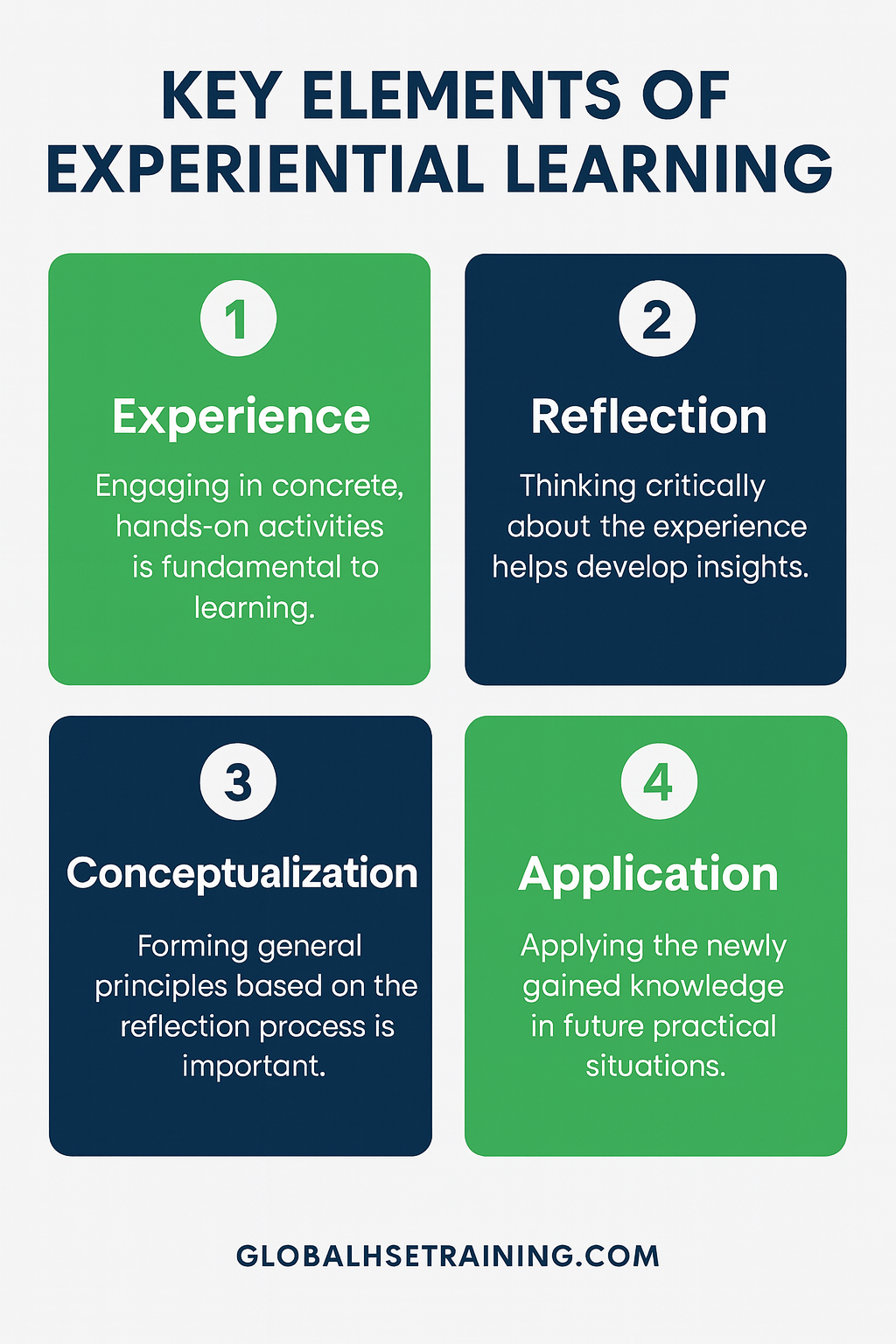
The Role of Reflective Models in NVQs
To avoid vague or repetitive writing, learners often use reflective models. These give your reflection a clear structure so you can express your learning professionally and effectively.
Reflective models used in vocational qualifications include:
-
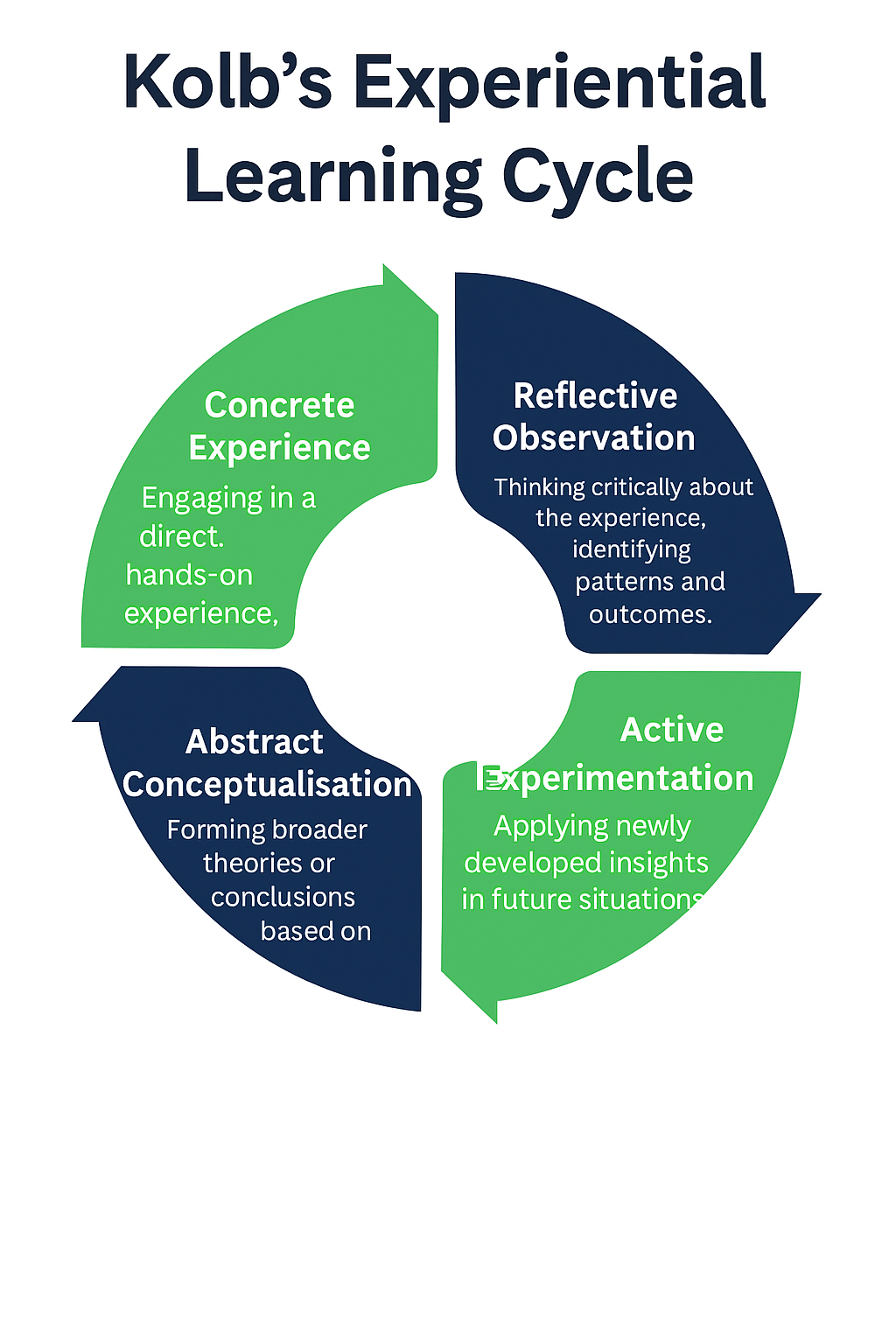
Kolb’s Experiential Learning Cycle
-
Gibbs’ Reflective Cycle
-
Schön’s Reflection-in-Action / Reflection-on-Action
-
APDR (Assess–Plan–Do–Review)
These models help you write with clarity, structure, and depth.
Kolb’s Learning Cycle
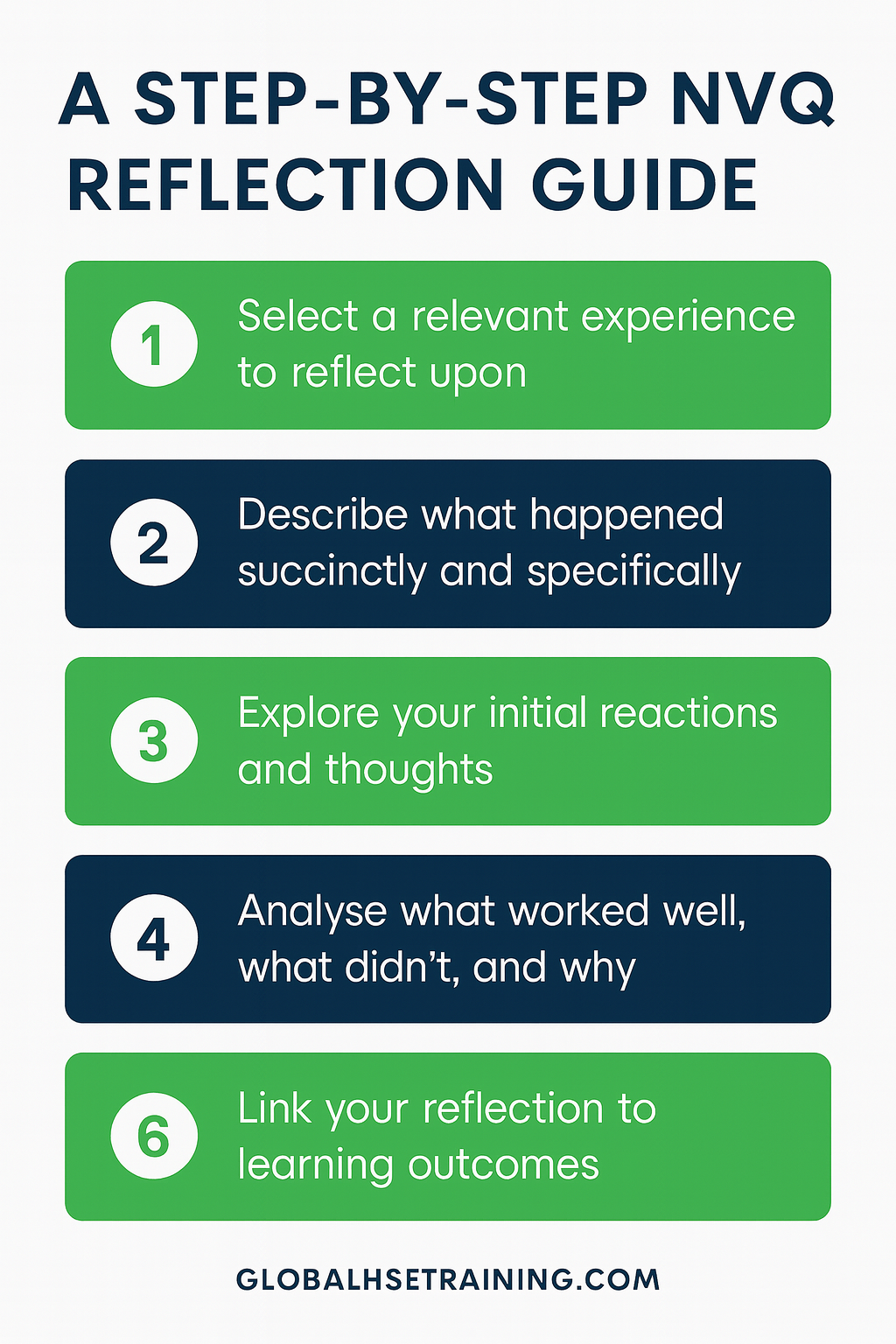
Step-by-Step Guide to Writing a Perfect NVQ Reflective Account
Below is the exact process NVQ assessors expect learners to follow.
Step 1: Identify the Real Situation or Task
Choose a real activity you personally carried out. Examples:
-
Risk assessments
-
Incident investigations
-
Toolbox talks
-
Equipment checks
-
Contractor supervision
-
Safety inspections
The activity must link to an NVQ performance criterion.
Step 2: Describe What Happened (Short, Factual)
Keep it objective:
-
What happened?
-
Where and when?
-
Who was involved?
-
What was your role?
Avoid descriptions like “I felt…” — that comes later.
Step 3: Explain What You Did and Why
This shows the assessor your competence.
Explain:
-
Actions you took
-
Procedures followed
-
Legal or safety requirements considered
-
Alternatives you considered
-
Why this method was best
Example:
“I followed the risk assessment hierarchy of control to select appropriate protective measures.”
Step 4: Reflect on What Went Well
Examples:
-
I communicated clearly
-
I used the correct procedure
-
The team responded well
-
Hazards were controlled effectively
This demonstrates strengths in your approach.
Step 5: Reflect on What Could Have Gone Better
Every reflective account must show honest improvement:
-
Documentation could be done earlier
-
I could have briefed the team more clearly
-
I should have double-checked equipment
-
I could have escalated the issue sooner
Showing development is essential for NVQs.
Step 6: Explain What You Learned
Examples:
-
Technical skills
-
Safety awareness
-
Communication improvements
-
Better planning
-
Improved decision-making
This proves you gained value from the experience.
Step 7: Link Your Reflection to NVQ Criteria
This is important:
-
Match actions to specific performance criteria
-
State how your evidence proves competence
-
Refer to knowledge statements if required
This helps assessors map your evidence quickly.
Step 8: Attach Supporting Evidence
Your reflective account is stronger when supported with:
-
Photos
-
Checklists
-
Risk assessments
-
Witness statements
-
Emails or logs
-
Toolbox talk sheets
-
Supervisor feedback
Step-by-Step NVQ Reflection Guide